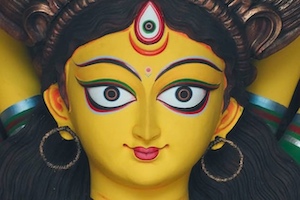
‘Cambridge Goddess’: How Durga idol found permanent home at Cambridge University museum
Times of India | 10 September 2026The idol was worshipped at the community Durga Puja organised by the Indian Cultural Society (ICS), Cambridge, till it found a permanent home at the Cambridge University museum. ICS is an association largely comprising Bengalis teaching or studying at Cambridge.
As ICS enters its 25th year of Durga Puja celebrations, the organisers are trying to collaborate with Cambridge University on another conservation project involving their idol.
“Since one of our idols is already being preserved by the Museum of Archaeology and Anthropology, University of Cambridge, we feel the need to do something similar in this milestone year,” said Nandan Sengupta, one of the Puja organisers who also teaches management at the university.
“At that time, the Museum of Archaeology and Anthropology showed great interest. It took some time to establish all operational details, including the logistics of transferring the idol safely to the museum. After detailed planning and an operational review, the idol was taken in. It remains there at the museum at the heart of Cambridge," said Sengupta.
"It makes sense to collaborate with Cambridge University to do something, apart from preserving our protima (idol), that evokes interest among people from all over the world who come to study or teach in Cambridge about Durga Puja, aligning with the Unesco recognition. In our 25th year, we are reminiscing about our journey and achievements that we could be proud of and pass on to the next generation so they can continue maintaining their heritage and culture,” Sengupta aded.
10 years ago, ICS members felt the need for a new Durga idol, which got them thinking about what would happen to the old idol.
Since there is no provision for “bhasan” or visarjan (immersion) in the UK, immersing the idol in a river would be considered polluting. If permitted, any bhasan would have to be a ritualistic gesture, after which the idol would have to be lifted from the river and disposed of properly.
That would have been expensive, and many elderly members would not have been comfortable with the process. The younger members started looking for alternatives.
Apart from donating the idol to an upcoming or newly formed Durga Puja committee, another remote option was to approach Cambridge University to check if it would be interested in displaying the idol as part of heritage and cultural preservation.
Despite several hindrances, this was the easier part of a two-part job, the second being the disposal of the old idol. Idols are either kept in individuals’ homes or stored in warehouses.
“The University of Cambridge, which has seven museums, agreed to keep the idol eternally as a heritage icon. What a relief it was for us,” said Sengupta.
“The logistics were not simple, but for a museum it was not much of a challenge. Struck by her gorgeous appearance, visitors want to know more about the culture and heritage that she represents. The museum staff lovingly started calling her ‘The Cambridge Goddess’,” said Sengupta.
After the installation of the Cambridge Goddess, Mark Elliott, senior curator for anthropology, wrote to the Puja organisers: “The pratima is a very important addition to the Museum as an example of the devotional tradition in West Bengal and of twenty-first century work by the artists of Kumartuli. Moreover, I think its greatest value for us is to enable us to represent the living South Asian heritage of Cambridge. It is as a Cambridge object, as well as a Kolkatan, Bengali and Hindu one, that I would like it to have an impact on our galleries and our audiences."
“Today we have installed Her in the main anthropology gallery, where She will now be on permanent display and accessible to all visitors, particularly members of the Indian Cultural Society and the local South Asian community more generally. I’m delighted to say that she has already made a big impact on our staff and on visitors. I would be happy to welcome you to the Museum to show you myself, but please also feel free to visit, as always, any time the Museum is open...”